


Feature Article
On Being Engaged
December 2010 Issue
Mary A. Banks BS, BSN
Director, BU/BMC IRB
Author has nothing to disclose with regards
to commercial support.
- Introduction
- OHRP Engagement Guidance
- Engagement in Human Subjects Research vs. Key Personnel
- Institutional Variability
- Options for IRB Review
- Summary
- Quiz
“A verbal contract isn't worth the paper it's written on.” ~Samuel Goldwyn, Goldwyn's Law of Contracts
 These days there is a lot of media coverage on the topic of “engagement”--specifically, the engagement of Prince William to Kate Middleton! A less chic and far less glamorous discussion about “engagement” centers around the federal guidance on the engagement of institutions in human subjects research. This article provides some additional details regarding the term “engagement in research”, and offers assistance for BU/BMC investigators in interpreting the guidance and applying it to their research..
From the IRB perspective, the term “engagement” relates to the OHRP guidance on Engagement of Institutions in Human Subjects Research. In general, this document states that an institution is considered engaged in a human subjects research project when its employees or agents, for the purposes of the research project, are engaged in human subjects research. The document then goes on to provide example scenarios with an explanation as to whether or not they are considered by OHRP to represent engagement in human subjects research.
- Section III.A describes scenarios where institutions/investigators would be considered to be engaged in human subjects research.
- Section III.B describes scenarios where institutions/investigators would be considered to not be engaged in human subjects research
These scenarios are not intended to be all-inclusive. The determination as to whether an investigator is engaged in research depends on the specific details of the research study--and sometimes making the determinations can be tricky. In the end, it is the IRB that makes the final determination as to whether the investigators (the institution) are engaged in human subjects research.
 The following document (Scenarios related to engagement in research.doc) summarizes, in less regulatory terms, the types of research activities that are likely to be determined to constitute engagement, and those that are likely to NOT constitute engagement based on the OHRP guidance. This information may be useful to investigators to help them anticipate whether certain activities conducted by others at other institutions as part of their research might constitute engagement in the research. This engagement determination is important, especially when investigators from more than one institution or site are involved, as it drives the decision about whether more than one IRB review is necessary.
In general, each institution whose investigators are engaged in federally funded non-exempt human subjects research, is responsible under the terms of its Federal Wide Assurance (FWA, which is an agreement with the Federal Government) for ensuring that their research has IRB review and approval. Many institutions extend the terms of their FWA to include all research, not just federally funded research.
Even with the level of detail and the specific examples provided in the federal guidance, a number of questions still arise about whether certain activities constitute engagement in research. In one important correspondence with OHRP, a question was posed as to whether the employees of a survey firm, hired by investigators to conduct research surveys, are engaged in the research. Here is the OHRP response.
Engagement in Human Subjects Research vs. Key Personnel
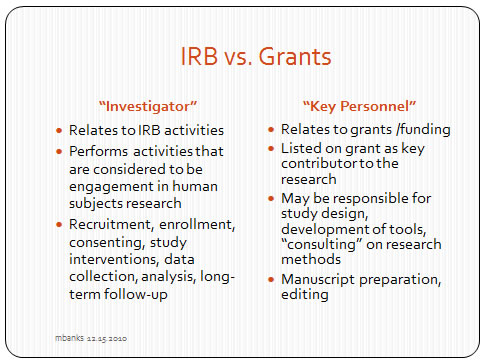
When investigators write a grant or funding proposal, they are usually required to name the “key personnel” on that grant or as part of the proposal. Along with the PI and co-investigators, this would include people who are responsible for the design of the research, perhaps those who will be assisting with data analysis and statistical design, as well as those who may be writing the manuscripts or consulting on development of study instruments. A number of these roles are in keeping with the definition of “Key Personnel”, but do not necessarily meet the criteria for being “engaged in human subjects research” as described in the OHRP guidance.
 This distinction in terminology is frequently confusing for investigators who tend to want to list on the IRB protocol all the Key Personnel from the grant. While it might be true that all “Key Personnel” are investigators “engaged in human subjects research”, it is just as likely that some “Key Personnel” are not by definition “engaged in human subjects research”. Conversely, it is likely that all investigators “engaged in human subjects research” are not “Key Personnel” on the grant.
While most institutions refer to the OHRP guidance in their determinations regarding engagement in research, institutions always have the option to set institutional policy that is more stringent than the federal requirements.
 One example of this can be seen at the Veterans Administration (VA). Under the OHRP guidance, certain research activities (such as posting recruitment fliers or handing out recruitment materials in an institution) would not be considered to constitute engagement in research, and IRB review by the institution where the fliers were being posted would not be required. However, this is not true at the VA. According to VA policies, if an investigator from a non-VA institution wishes to recruit subjects from the VA, then a VA Principal Investigator (PI) must be appointed and the protocol must undergo IRB review by the VA IRB.
Once the IRB determination has been made that investigators from an institution are engaged in human subjects research, then IRB review will be required on behalf of that institution. The institution engaged in the research has several options for ensuring IRB review:
 Option 1: Review by an Internal IRB
Institutions have the option of constituting one or more “internal” IRBs at their site that are designated to conduct IRB review. These internal IRBs must be listed on the institution’s Federal Wide Assurance. BU/BMC has 4 duly constituted, internal IRB Panels that are designated on the BU/BMC FWA and can conduct IRB review on behalf of the institution: Panels Blue, Green and Purple at the Medical Campus IRB; and the Charles River IRB.
 Option 2: Review by an External IRB (Commercial or Central IRB)
The second option is for an institution to contract with a commercial or central IRB to conduct IRB review on their behalf. In order to do this, an institution must designate that commercial IRB as an IRB that is allowed to review protocols on its behalf. A formal agreement signed by both parties must be in place, as well as policies or SOPs outlining the circumstances under which the commercial IRB can review protocols for the institution. An example of this is the arrangement that BU/BMC has with Western IRB (commonly known as WIRB). BU/BMC has a formal agreement in place that allows for certain studies (i.e., industry-sponsored multi-center clinical trials) to be sent to WIRB. WIRB is listed as a designated IRB on the BU/BMC FWA. There are SOPs in place regarding the forms to be used and the pre-review procedures that investigators must follow to submit their protocols from BU/BMC to WIRB. (For more details about these procedures, please see the IRB website www.bumc.bu.edu/irb under Research with Other Institutions.)
 Option 3: Delegating IRB Review to another Institution’s IRB
Under certain circumstances, the BU/BMC may agree to delegate its responsibilities for IRB review to another institution’s IRB to eliminate the need for duplicate IRB review. This process occurs through a formal signed agreement called an Institutional Authorization Agreement or IAA between the two institutions. A number of factors determine whether BU/BMC will consider delegating IRB review to another institution, the most significant of which are the risk level of the study, the risk level of the procedures being conducted by the BU/BMC investigators, who is the prime recipient of the award (if BU/BMC is prime, then delegation is less likely), and the specifics regarding the other institution.
Investigators can request that the BU/BMC IRB consider delegation of IRB review to another institution for their research (BU/BMC is Institution B); or that the BU/BMC IRB consider accepting delegation of IRB review for another institution (BU/BMC is Institution A). This is done by completing one of two forms and attaching them to the IRB submission:
Single IRB Review Request (BU/BMC is Institution A) is when BU/BMC will be the IRB of record.
Single IRB Review Request (BU/BMC is Institution B) is used when BU/BMC will delegate to the other institution’s IRB.
These forms and more information can be found on the IRB website at www.bumc.bu.edu/irb on the med campus and www.bu.edu/irb on the Charles River Campus.
The OHRP guidance on engagement in human subjects research is an important tool for investigators to use to help them determine when IRB review will be required for collaborations with other institutions participating in their research.
Note: The December session of the Clinical Research Seminar series also addressed the topic of engagement in human subjects research. A video version of that presentation, along with the Powerpoint slides and handouts, can be found at the Clinical Research Resources Office website.Quiz
This Quiz applies to the recertification period from July 1, 2009 to June 30, 2011.
Click
here and close window if you are a BUMC researcher
and would like to take the quiz now.