
Reducing Implicit and Explicit Bias in Research
February/March 2021 Issue
Author(s):
-
Matthew Ogrodnik, MS, CIP,
Editor, CR TIMES -
Megan Bair-Merritt, MD, MSCE,
 Chair of Committee to Reduce Implicit and Explicit Bias in Research
- Reducing Implicit and Explicit Bias in Research
- For more information on implicit bias
- To Test Yourself for Bias
In Fall 2020, Boston Medical Center and Boston University School of Medicine (BUSM) established the “Committee to Reduce Implicit and Explicit Bias in Research.” The Committee’s stated aim was to recommend systems changes to identify and minimize sexism, racism, and other forms of bias in research design and reporting. After convening regularly to fulfill this mission, the Committee has now released the full Report from the Committee to Reduce Implicit and Explicit Bias in Research. This Feature Article will discuss the recommendations outlined in this report, with a focus on how they affect the IRB submission process. The majority of the information in this article comes directly from this Report; and you are strongly urged to read the original text in its entirety for a detailed description of the background, and for a complete description of the Committee recommendations.
As described in the Report, the Committee acknowledged that changing the culture and practice of medical research is complex, and there is no “quick fix”; instead, reducing bias in research will require continuous, iterative improvements over time, aimed at addressing some of the underlying reasons that research with these biases persists. Specifically, systems-level changes must address the following:
- too few “checks” exist to question potentially biased methodology and scientific writing;
- scientific teams, journal editorial boards and reviewers often lack diversity;
- culture and climate of medical institutions often tolerate explicit and implicit biases; and
- there is inadequate education in this area for many current and future scientists.
Improving these issues will require time and effort from multiple stakeholder groups. The Report also highlights core values that underscore the development of the published recommendations:
(1) moving towards the shared goal of minimizing bias in research requires collective responsibility;
(2) broad-based training is critical;
(3) efforts should focus on support and education as opposed to punitive action; and
(4) given the complexity of this issue, and the role of our Institution in forging this path across the country, implementing these recommendations will need to be done within the frame of continuous improvement.
With these values as the backdrop, the recommendations are as follows:
Committee Recommendations:
1. Create and implement a system to minimize racism, sexism and other forms of bias in research design and reporting by first recognizing research studies that may be impacted by bias, and second by providing supportive resources when needed.
Implementation of this change has begun, and directly affects the IRB submission process. Specifically, this recommendation includes the following steps:
- As part of the initial submission for every study submitted to the IRB, the Principal Investigator (PI) of the study must fill out and attach the Reducing Explicit and Implicit Bias in Research Form. PIs are prompted to do this in the Initial Review Submission Form:
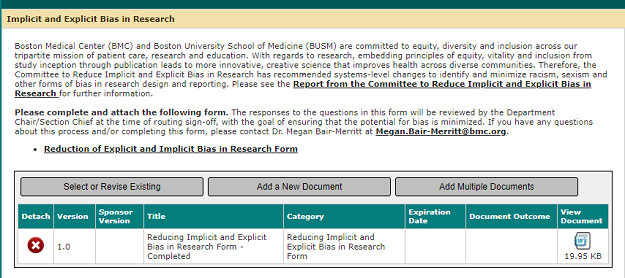
The form is linked to this section, and asks the following questions:
- Study Title
- Names, titles and Departments of members of the study team
- Abstract including intro/background and methods
- If the study is led by a student, resident or fellow, name of the trainee’s mentor and how frequently are the mentor and trainee meeting?
- Does your team have the expertise to implement the study as designed, such as experience with the design (surveys, cohort studies), or with the analyses that you are proposing? If yes, describe briefly the expertise of each member of the team and their experience with the proposed methods? If no, what skills are you missing?
- Could the study question, methods, or results potentially harm a community that historically has been marginalized?
- What processes do you have in place to ensure that decision-making is as free from implicit and explicit biases as possible when the study is implemented? How will you build into your study team meetings times to pause and ask questions about the degree to which there is actual or perceived implicit and explicit bias in your approach?
- How will you measure and analyze demographic variables such as sex, gender, race/ethnicity and other forms of identity in your study?
- Timeline (including planned abstract and paper submission)
Once completed, the form must be attached in this section in the Initial Review Submission form. By doing this, it will be easily visible on the sign-off screen for the Department Chair/Section Chief.
As part of the Department Chair/Section Chief sign-off, Chairs/Chiefs must:
- sign off on the IRB submission, and;
- check a box to confirm that they have evaluated the potential for the study to have implicit and explicit biases.
This is how the sign-off page looks in INSPIR:
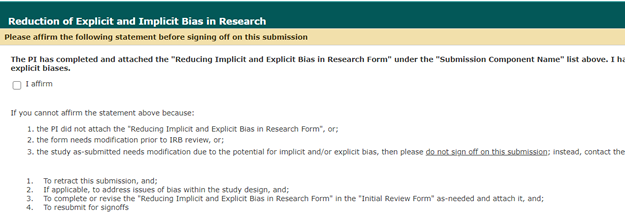
The sign-off attestation is as follows:
__________________________________________________
As the Department Chair/Section Chief, I have reviewed the "Implicit and Explicit Bias Evaluation Form" attached in the "Submission Component Name" list above. I have evaluated the potential for the study to have implicit and explicit biases and I have determined that the study may proceed as-submitted.
□ I affirm
If you cannot affirm the statement above because:
- the PI did not attach the "Implicit and Explicit Bias Evaluation Form", or;
- the form needs modification prior to IRB review, or;
- the study as-submitted needs modification due to the potential for implicit and/or explicit bias, then please do not sign off on this submission; instead, contact the PI on this study and ask them:
- To retract this submission, and;
- If applicable, to address issues of bias within the study design, and;
- To complete or revise the "Implicit and Explicit Bias Evaluation Form" in the "Initial Review Submission Form" as-needed and attach it, and;
- To resubmit for signoffs.
Therefore, the sign-off should not be granted until the Chair/Chief has confirmed that the potential for bias has been adequately minimized.
- In order to help PIs and Chairs determine how bias can be minimized, the Committee recommends the formation of a consultative group. A small group of researchers with expertise in research methods, biostatistics, and explicit and implicit biases will serve as a consultative service. If Chairs have concerns, or if investigators desire support, researchers will be put in contact with members of this consultative service with the appropriate related expertise (i.e., appropriate use of race in regression modeling).
- The Committee recognizes that this recommendation does not address the many current, ongoing studies. As such, the Committee recommends that each Chair/Chief temporarily consider options for reviewing potentially concerning manuscripts prior to submission.
The IRB analyst reviewing the initial submission will check to make sure that the Reducing Explicit and Implicit Bias in Research Form is attached; and if it is not attached, will reach out to notify the PI and the Department Chair/Section Chief of the omission, and of the need to complete and review this form. That is the extent of the IRB’s role in this process; the IRB will not conduct a rigorous review of the responses to the questions in the form. If you have questions about how to minimize the potential for bias, or if you or your Chair/Chief identify the need for additional support, you should direct your questions to Megan Bair-Merritt, MD, MSCE at megan.bair-merrit@bmc.org.
The next recommendations are equally as important, but do not directly affect the IRB submission process. These will be summarized; see the Report from the Committee to Reduce Implicit and Explicit Bias in Research for the full description:
2. Continue and expand education of medical students and doctoral students, residents, fellows, faculty and leadership about the history of racism and sexism in medical research as well as ways in which to combat these biases. This education must be ubiquitous across career levels (from students to senior faculty) and must include continuous learning over time.
3. Leverage and customize technology platforms to identify biased language in publications.
4. Create an online platform for anonymous reporting of concerns related to explicit and implicit bias in research.
5. Design an evaluation that allows BMC/BUSM to track process and outcome metrics.
6. Professionalism at BMC/BUSM. The Committee recognizes an inclusive definition of professionalism that prioritizes and celebrates diversity, and recognizes that professionalism standards vary based on specialty and community.
As highlighted earlier, effectively reducing implicit and explicit bias in research will be a continuous process that requires commitment from our research community at large. The Committee welcomes input on effective ways to implement the published recommendations, as well as suggestions for additional changes and processes that have not been included. By reducing bias in research, our community can produce more innovative, creative science that improves health across diverse communities.
For more information on implicit bias:
Ruhl , C. (2020, July 01). Implicit or unconscious bias. Simply Psychology. https://www.simplypsychology.org/implicit-bias.html
Greenwald, A.G., Krieger, L.H. Implicit Bias: Scientific Foundations. California Law Review
Vol. 94, No. 4 (Jul., 2006), pp. 945-967. https://doi.org/10.2307/20439056
Brownstein, M. Implicit Bias. The Stanford Encyclopedia of Philosophy (Winter 2019 Edition), Edward N. Zalta (ed.). https://plato.stanford.edu/archives/win2019/entries/implicit-bias/
See also the References in the Report from the Committee to Reduce Implicit and Explicit Bias in Research..
To Test Yourself for Bias:
Implicit Association Test
From the Social Psychology Network
.