


Feature Article
Either You're In or You're Out!
Screening Research Subjects
October, 2006 Issue
Anna W. Martin, MPH
Author has nothing to disclose with regards
to commercial support.
Educational Objectives:
At the end of this activity, participants should be able to:
- Recommend consent procedures for specific research screening activities.
- Assess which activities are being done for clinical care purposes and which are being done for the purposes of research.
- Identify which research activities are part of the screening and which are part of the main study.
- Recognize that if identifiable data is collected along with research data, subjects must be consented or the IRB must waive consent.
- Introduction
- Is it research?
- What is the risk?
- Screening without consent
- Is consent required?
- Counting Subjects
- Conclusion
- Quiz
 Screening
activities are a significant aspect of research recruitment used to determine
whether or not potential subjects meet the eligibility criteria. Screening
can be simple or complex, depending on the research, and can include activities
as basic as asking someone’s age and occupation, or as extensive
as obtaining a blood sample or taking an x-ray. While investigators are
usually clear about which screening activities they want to institute
as part of their study, they frequently become confused when trying to
figure out when informed consent is needed for screening activities, when
consent can be done by telephone or mail rather than in person, and whether
subjects who have been screened should be counted in their research numbers.
Screening
activities are a significant aspect of research recruitment used to determine
whether or not potential subjects meet the eligibility criteria. Screening
can be simple or complex, depending on the research, and can include activities
as basic as asking someone’s age and occupation, or as extensive
as obtaining a blood sample or taking an x-ray. While investigators are
usually clear about which screening activities they want to institute
as part of their study, they frequently become confused when trying to
figure out when informed consent is needed for screening activities, when
consent can be done by telephone or mail rather than in person, and whether
subjects who have been screened should be counted in their research numbers.
Here is a helpful tip IRB reviewers often use to tackle this topic. A research study can often be broken down into a timeline of components: study design, screening, interventions, follow-up, and data analysis. The procedures and risk level may vary widely among these phases. By thinking about each of these components separately, the regulatory requirements often become apparent. If the PI considers the screening component as a mini-study that happens before the main study, she can then more easily separate out the activities, risk level, and consent requirements for the screening and determine which regulatory requirements must be met.
All screening activities being done for research purposes - from
asking a question or searching records, to more invasive tests and procedures
- must be described in the IRB application. For example, if a subject
is having blood 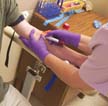 drawn
for clinical (treatment or diagnostic) purposes and the investigator will
only be looking at the cholesterol level from the medical record to see
if the subject fits the inclusion criteria, then that blood draw was NOT
done for research purposes. The review of the medical record to obtain
the cholesterol level is the only research screening activity. Conversely,
if the PI requests that a little extra blood be drawn specifically so
that the PI can check the cholesterol level to see if the subject meets
the eligibility criteria, then this sample is being obtained for research
purposes.
drawn
for clinical (treatment or diagnostic) purposes and the investigator will
only be looking at the cholesterol level from the medical record to see
if the subject fits the inclusion criteria, then that blood draw was NOT
done for research purposes. The review of the medical record to obtain
the cholesterol level is the only research screening activity. Conversely,
if the PI requests that a little extra blood be drawn specifically so
that the PI can check the cholesterol level to see if the subject meets
the eligibility criteria, then this sample is being obtained for research
purposes.
 Once
the research screening activities have been identified, the next step
is to figure out the risk level of these screening activities. The risk
level is the key factor in determining which consent requirements must
be met for the eligibility screening. Frequently, the risk level of screening
activities is different than the risk level of the activities in the interventional
portion of the study. If screening activities represent no more than minimal
risk to subjects, then the IRB may allow for a waiver of consent or waiver
of documentation of consent FOR THE SCREENING PORTION of the study even
if the full study represents greater than minimal risk. If, however, the
screening activities represent greater than minimal risk, then consent
cannot be waived under most circumstances (“minimal risk”,
OHRP definition 45
CFR 46.102 (i)). When discussing risk, the IRB considers not only
the risk of physical harm but also the potential for any harm to subjects.
Once
the research screening activities have been identified, the next step
is to figure out the risk level of these screening activities. The risk
level is the key factor in determining which consent requirements must
be met for the eligibility screening. Frequently, the risk level of screening
activities is different than the risk level of the activities in the interventional
portion of the study. If screening activities represent no more than minimal
risk to subjects, then the IRB may allow for a waiver of consent or waiver
of documentation of consent FOR THE SCREENING PORTION of the study even
if the full study represents greater than minimal risk. If, however, the
screening activities represent greater than minimal risk, then consent
cannot be waived under most circumstances (“minimal risk”,
OHRP definition 45
CFR 46.102 (i)). When discussing risk, the IRB considers not only
the risk of physical harm but also the potential for any harm to subjects.
Consider the example of a questionnaire being completed by subjects for
screening. While a questionnaire may seem like a low risk activity, if
identifiable information about the subjects is being collected along with
information about their use of illegal substances, then this would represent
 greater than minimal risk. Merely by participating in this study, research
subjects could have their identity associated with illegal substance use,
and, if this research data got into the wrong hands, it could put at risk
the subjects’ social standing, employability, etc. OHRP explains
that research is more than minimal risk when data of a sensitive nature
is being collected “where knowing the identity of subjects may reasonably
place them at risk of criminal or civil liability or be damaging to subjects’
financial standing, employability, insurability, and reputation or be
stigmatizing” (Federal
Register: November 9, 1998 (Volume 63, Number 216)).
greater than minimal risk. Merely by participating in this study, research
subjects could have their identity associated with illegal substance use,
and, if this research data got into the wrong hands, it could put at risk
the subjects’ social standing, employability, etc. OHRP explains
that research is more than minimal risk when data of a sensitive nature
is being collected “where knowing the identity of subjects may reasonably
place them at risk of criminal or civil liability or be damaging to subjects’
financial standing, employability, insurability, and reputation or be
stigmatizing” (Federal
Register: November 9, 1998 (Volume 63, Number 216)).
If this same investigator were to ask subjects about their illegal substance use, but did not record the subjects’ names or any other information that would allow their identity to be readily ascertained, then the risk of this screening activity would be much lower. Assuming that subjects are interviewed in an appropriately private area, the only risk or discomfort would be the time it takes to answer the questions and the possibility of the subjects becoming distressed during the interview. The risk level remains low if the number of questions is kept to a minimum and the questions are asked by someone with the appropriate sensitivity and expertise. The risk only goes up if the illegal substance information is recorded along with the subjects’ names or other identifiers. This includes situations where the study data is recorded on a separate sheet from the subject identifiers but there is a master code linking the data to the subjects’ identity.
 So,
being precise about exactly what, how and when information is being recorded
during screening is very important for the IRB review. If the researcher
records the subjects’ names and the study data and then blacks
out the names at a later date, then the identifiers were recorded at some
point and so the study data was identifiable. Conversely, if the researcher
interviews a subject but only records study data in a completely anonymous
fashion on the data collection sheet, without any links that would allow
the study data to be matched to individual subjects, then this study data
would not be considered by the IRB to be “identifiable” data.
So,
being precise about exactly what, how and when information is being recorded
during screening is very important for the IRB review. If the researcher
records the subjects’ names and the study data and then blacks
out the names at a later date, then the identifiers were recorded at some
point and so the study data was identifiable. Conversely, if the researcher
interviews a subject but only records study data in a completely anonymous
fashion on the data collection sheet, without any links that would allow
the study data to be matched to individual subjects, then this study data
would not be considered by the IRB to be “identifiable” data.
What if a PI wishes to contact all of her patients with diabetes to see
if they will participate in a study about diabetics who live alone and
receive public assistance? She might first obtain a HIPAA
Preparatory to Research Form and request a list from medical records
of all of her BMC patients with  diabetes
and their phone numbers. With that list (Sheet #1) and IRB approval, she
could then start calling potential subjects on the list to tell them about
the study. She would need a SEPARATE data collection sheet (Sheet #2)
with the three data points to be collected. She would then give each person
a brief description of the study, confirm that they are diabetic, and
then ask if they live alone and if they receive public assistance. She
would record this data on Sheet #2 but include no identifiable data or
code number that would link the subjects to the identifiers. If it turns
out that the subject being screened fits the study inclusion criteria
(diabetic, lives alone, receives public assistance) she could then consent
him to participate in the study. If the subject did not meet the inclusion
criteria or did not wish to answer the questions or join the study, she
could complete Sheet #2 without identifiers, cross his name off Sheet
#1 and move on. At the end of the screening process she could report the
screening data in the aggregate (i.e. XX percent of the patients screened
had diabetes and lived alone), but the screening results could not be
linked back to individual subjects.
diabetes
and their phone numbers. With that list (Sheet #1) and IRB approval, she
could then start calling potential subjects on the list to tell them about
the study. She would need a SEPARATE data collection sheet (Sheet #2)
with the three data points to be collected. She would then give each person
a brief description of the study, confirm that they are diabetic, and
then ask if they live alone and if they receive public assistance. She
would record this data on Sheet #2 but include no identifiable data or
code number that would link the subjects to the identifiers. If it turns
out that the subject being screened fits the study inclusion criteria
(diabetic, lives alone, receives public assistance) she could then consent
him to participate in the study. If the subject did not meet the inclusion
criteria or did not wish to answer the questions or join the study, she
could complete Sheet #2 without identifiers, cross his name off Sheet
#1 and move on. At the end of the screening process she could report the
screening data in the aggregate (i.e. XX percent of the patients screened
had diabetes and lived alone), but the screening results could not be
linked back to individual subjects.
At this point it might be helpful to think again about the idea of considering screening activities as a mini-study separate from the larger study. By considering screening activities as distinct from the interventional portion of the study, the consent requirements may become more obvious. Here are some examples:
- Phone response to posted ad: A recruitment ad is
posted asking for volunteers to call the study coordinator
 if they are over 18, are a smoker, and have tried a nicotine patch.
A potential subject calls, the study coordinator reviews the study criteria
with him and the caller agrees that he meets the criteria. The coordinator
doesn’t record any of that data (smoking history, medication use)
but does take the caller’s name and phone number and makes an
appointment for the caller to come in to the clinic to enroll in the
study. In this case no research data has been collected yet and
linked to identifiable subjects. Consent with all the required elements
is not required for this type of screening.
if they are over 18, are a smoker, and have tried a nicotine patch.
A potential subject calls, the study coordinator reviews the study criteria
with him and the caller agrees that he meets the criteria. The coordinator
doesn’t record any of that data (smoking history, medication use)
but does take the caller’s name and phone number and makes an
appointment for the caller to come in to the clinic to enroll in the
study. In this case no research data has been collected yet and
linked to identifiable subjects. Consent with all the required elements
is not required for this type of screening. - Review of medical records for lab results collected for clinical
(non-research) purposes: A PI from the OB clinic is starting
a study of pregnant women who are anemic to see how they respond to
a new drug ANEMIABEGONE. The PI asks Medical Records to run a list of
his patients from the OB clinic. He then asks them to query the medical
 records database for the hematocrit for each patient on the list.
In this case he needs a HIPAA
Preparatory to Research Form to allow for creation of the list of
pregnant women to be used for research purposes. Then, because he wants
to look into their medical records (for research purposes) and record
their lab values he needs to either obtain the subjects’ consent
or request an IRB Waiver of Consent (and HIPAA
Waiver of Authorization) from the IRB. Since this screening activity
is no more than minimal risk, the IRB would likely grant a waiver of
consent if Section J4 of INSPIR and the HIPAA Waiver of Authorization
are completed.
records database for the hematocrit for each patient on the list.
In this case he needs a HIPAA
Preparatory to Research Form to allow for creation of the list of
pregnant women to be used for research purposes. Then, because he wants
to look into their medical records (for research purposes) and record
their lab values he needs to either obtain the subjects’ consent
or request an IRB Waiver of Consent (and HIPAA
Waiver of Authorization) from the IRB. Since this screening activity
is no more than minimal risk, the IRB would likely grant a waiver of
consent if Section J4 of INSPIR and the HIPAA Waiver of Authorization
are completed. - Collecting study data about subjects before enrolling them
into the interventional phase of the study: Here a PI is planning
a clinical trial of a new medication for patients with hypertension.
The screening interview, which takes about an hour, is done by phone
to ensure each subject’s eligibility before scheduling the subject
in the clinic. Important research data is collected during the screening
that must be linked to the subject so that the lengthy interview does
not have to be repeated and the data can be used in the study. The
investigator must obtain consent from the subject PRIOR to recording
any identifiable data. If the screening data is no more than minimal
risk, the IRB may approve a Waiver of Documentation of
 Consent.
With this waiver, “verbal consent” can be obtained from
the subject over the phone. The PI must complete Section J3 of INSPIR,
a HIPAA Waiver of Authorization (since the subject won’t be signing
a HIPAA Authorization before the screening), and Section Q of INSPIR
(the telephone consent script). On the other hand, if the data being
collected represents greater than minimal risk, then the PI will have
to obtain signed consent from the subject before starting the screening.
This would be done by mailing the subject a copy of the consent form
to be signed and returned before starting the screening. In both instances,
since all subjects are consented prior to data collection, then all
data (including the data on the subjects who consented but failed screening)
may be used in the data analysis.
Consent.
With this waiver, “verbal consent” can be obtained from
the subject over the phone. The PI must complete Section J3 of INSPIR,
a HIPAA Waiver of Authorization (since the subject won’t be signing
a HIPAA Authorization before the screening), and Section Q of INSPIR
(the telephone consent script). On the other hand, if the data being
collected represents greater than minimal risk, then the PI will have
to obtain signed consent from the subject before starting the screening.
This would be done by mailing the subject a copy of the consent form
to be signed and returned before starting the screening. In both instances,
since all subjects are consented prior to data collection, then all
data (including the data on the subjects who consented but failed screening)
may be used in the data analysis.
Finally, how does an investigator determine whether screened subjects
count towards the study enrollment numbers (Section G of INSPIR)? The
short answer is, if subjects have been consented (or would have been consented
if consent had not been waived), then they are considered research subjects
and their numbers count towards the study enrollment numbers in the INSPIR
application. This rule of thumb, however, may not apply to all studies
across the board due to the unique nature of study designs. Also, it is
important to note that this rule will likely differ from the way subjects
are counted for the study sponsor. The reason for this is that sponsors
are usually interested in the number of subjects who complete the study,
whereas the IRB is interested in knowing about all subjects who
were put at risk (even if only the risk of loss of confidentiality) during
conduct of the research. For this reason, it is important for investigators
to discuss with the IRB and specify in the INSPIR application whether
screen failures are included in subject number totals, rather than unintentionally
over-enrolling. Failure to determine this at the onset of the study could
result in a protocol deviation if the IRB is counting screen failures
as part of the enrollment numbers and the investigator is not.
their numbers count towards the study enrollment numbers in the INSPIR
application. This rule of thumb, however, may not apply to all studies
across the board due to the unique nature of study designs. Also, it is
important to note that this rule will likely differ from the way subjects
are counted for the study sponsor. The reason for this is that sponsors
are usually interested in the number of subjects who complete the study,
whereas the IRB is interested in knowing about all subjects who
were put at risk (even if only the risk of loss of confidentiality) during
conduct of the research. For this reason, it is important for investigators
to discuss with the IRB and specify in the INSPIR application whether
screen failures are included in subject number totals, rather than unintentionally
over-enrolling. Failure to determine this at the onset of the study could
result in a protocol deviation if the IRB is counting screen failures
as part of the enrollment numbers and the investigator is not.
Screening is an integral part of the study design. It is the investigators’ responsibility to ensure that subjects are appropriately consented prior to any screening activities in accordance with the regulations. Even subjects who screened out of a study may have been put at risk. The IRB must ensure that adequate protections are in place to protect these subjects, as well as subjects who participate in all study interventions.
Quiz
This Quiz applies to the recertification period from July 1, 2007 to June 30, 2009. CME credits are also available.
Click
here and close window if you are a BUMC researcher
and would like to take the quiz now.